
Editor’s Note
In part 2 of the series “Sephardic Art and the First Modernist Sephardic Artists,” I look at three artists—Jules Pascin, Raphael Avraham Shalem, and Siona Tagger—whom I refer to as “the Oriental Prince,” “the Kabbalist,” and “the New Hebrew Woman.” These titles are not intended to reduce each of the artists to a single concept, but to highlight one overarching characteristic of each artist’s life and work in order to better illustrate the spectrum of dynamics that influenced this multifaceted cohort. Bohemianism, mysticism, Orientalism, and political engagement shaped the lives, legends, and work of many of the artists featured in this series. This prosopographical approach emphasizes these shared aspects of their lives and worlds, the array of personal, political, and aesthetic sensibilities they brought to their careers, and the ways they were viewed by contemporaries, and by critics then and now. While not necessarily serving as a unified portrait of these artists, my brief explorations of these figures, when taken together, will offer a polyphonic approach that recognizes the vast range of trajectories pursued by the first generation of Ladino-speaking Jewish artists in the early twentieth century. (Read part 1 on this series here.)
The Oriental Prince

The first artist of Ladino-speaking Sephardic background to gain international recognition was Jules Pascin1 (1885–1930), whose work my father has long known.2 Born into a wealthy Ladino-speaking family in Vidin, Bulgaria (nominally independent, but still an Ottoman vassal state) to parents from Salonica (now Thessaloniki) and Trieste, he followed a path shaped by geographic mobility, the experience of marginality, and a tumultuous personal life that inspired numerous legends and dramatic tales about him.
Due to his father’s business as a grain merchant, Pascin moved as a boy with his family to Bucharest, where there was also an established Sephardic community. According to one tale, by age fifteen, he was already frequenting brothels, where he created some of his first drawings; the madame of one of the establishments is rumored to have been his mentor in life and in art. Later, he ran away from his parents’ home—allegedly climbing out his window—and eventually headed for Vienna, then Munich and Berlin. In Germany, he pursued his ambitions as an artist, contributing drawings to Simplicissimus, a noted satirical magazine at the time, and illustrating works by Heinrich Heine. By late 1905, he moved to Paris and joined the art scene there. In 1914, because of his opposition to World War I and military service back in Bulgaria, he fled to the United States, waiting out the end of the war—and in 1920, he acquired American citizenship.3 Pascin’s US passport application4 noted that he was “thick lipped” and that his “eyebrows meet.” That tinge of racialized language, associated with his purported “Oriental” origins, remained with Pascin his whole life. His biographer, the noted French art critic Gaston Diehl, even referred to him as “the finest incarnation of the last oriental prince that ever existed.”5
Pascin returned to Paris in 1920, where he was associated with the famous group of émigré artists known as the School of Paris, which orbited Picasso and Matisse and included several Jews as part of subgroup known as the École Juive, like Marc Chagall and Amedeo Modigliani. In Paris, Pascin shifted to painting, pursued the life of a bohemian who became well-known in the social scene (he also befriended Hemingway), and earned the nickname the “Prince of Montparnasse.” Like Modigliani, Pascin was known as one of the peintres maudits (“accursed painters”) whose tormented souls allegedly contributed to their downfall. Pascin plunged into drinking, ultimately suffering from cirrhosis, and took many lovers. He married another painter in his social circle, Hermine David, and also maintained a relationship with a long-term mistress, Lucy Krohg; Joann Sfar’s graphic novel Pascin6 depicts, often with explicit illustrations, the artist’s sexual escapades.
Still, echoing his past efforts to escape or resolve his alienation, Pascin continued to feel that he did not belong: “I am the unhappiest man in the world,” he remarked at one point.7 Suffering from depression, he tragically took his own life in Paris at the age of forty-five, leaving instructions that he be buried by a rabbi according to the Jewish rite.8 (It was a controversial last wish, since those who take their own lives traditionally do not receive all the standard Jewish mourning rites.) Many art galleries in Paris closed on the day of his funeral.

Pascin also appears to have been the first painter from a Ladino-speaking background to work in the United States, although it appears that he had no contact with the organized Sephardic Jewish community there.9 During his stay in the US, however, Pascin could not escape his association with his “Oriental”—even unclassifiable—origins, which his contemporaries invoked to explain his character and his preference to depict societal outcasts in his art.
One critic observed that “nationalism to Pascin was sheer nonsense,” perhaps reflecting how he could not readily place himself in the consolidating national categories of his era.10 As an article in The Menorah Journal noted in 1925, Pascin’s familial roots in Spain, Italy, and the “Turco-Bulgarian” city of Viddin, in addition to his itinerant lifestyle—he also lived in Burcharest, Vienna, Munich, Paris, New York, New Orleans, and Cuba—made him “something of all of these—and none of them.” The author argued that Pascin’s frequent migration imbued him with a “genius for seeing and registering national characteristics which could only be born of a certain sardonic aloofness, a detachment of spirit not cultivated but innate.” Conversely, another article published in The Hebrew Standard identified him as “essentially a Jew,” and described him as being of “Spanish origin” with “much of the Oriental in him.” To the author’s mind, Pascin’s art was infused with “something strange,” “something indefinable”—an “Oriental flavor” and “Oriental temperament.” Another critic even described his surname as “weird, oriental, fabulous-sounding.” And yet another surmised that “a great deal of Levantine sensuality” initially shaped his disposition and his art.
These alleged characteristics were reflected in his chosen subject matter, which also included Black Americans—“the peculiar beauties of ebon-hued Americans”—as well as aesthetic influences attributed to Persian and Chinese art. Although he was highly exoticized, Pascin nonetheless gained admiration as an artist both Americans and Jews could “be proud of” (as The Hebrew Standard put it). The American Jewish World named him as “one of the greatest painters of his generation” despite—or perhaps because of—the fact that he “did not belong” in the “ultra-nationalistic age” during which he lived.
In retrospect, however, even though the Universal Jewish Encyclopedia (1939–1943) included an entry on him and his choice of subjects (“never mentioned in polite society”), some critics have been adamant that Pascin ought not to be viewed as a “Jewish” artist. But this likely has to do with art critics’ difficulty in conceiving of Jewish culture as anything other than Ashkenazi. In a profile of Pascin published in Commentary in 1958, the critic Alfred Werner claimed that whereas Modigliani (who wasn’t Ashkenazi either) articulated an awareness of his status as a Jew and vocally opposed antisemitism, Pascin never “demonstrated any consciousness of himself as a Jew.” As evidence, Werner cited the fact that Pascin only knew a few words of Yiddish, did not possess “any Zionist sentiment whatsoever,” and scarcely depicted Jews aside from “plump Jewish women in the Bronx and in Tunis.” Indeed, Pascin did paint a series of portraits of Tunisian Jewish women that seem to stand in dialogue with earlier Orientalist paintings of North African Jewish women by Eugène Delacroix. An underlying assumption in Werner’s comments is that Pascin’s native fluency in Ladino (which Werner doesn’t mention) did not count as “Jewish” at all. This is ironic, considering that Ladino is also known as “Judezmo,” which literally means “Jewish,” as does “Yiddish” itself.

Few critics seem to have noticed that Pascin also depicted his own Sephardic Jewish relatives in his work. In titling his early family portrait from 1907 “The Turkish Family,” Pascin perhaps knowingly mocked his critics, who would not be able to decipher the significance of the image.11 With his bearded grandfather in the back wearing a red fez and eyeglasses, his own likeness dressed in a suit and top hat at the center, and the women and children wearing the European fashions of the era (a fur-trimmed coat, a hat with a fancy feather, boots with high heels), Pascin offered a powerful representation of the sartorial transformations of multiple generations of a well-to-do Ottoman (verging on post-Ottoman) Jewish family at the turn of the twentieth century. But the painting’s title hides more than it reveals for the uninitiated viewer who may be unfamiliar with how the labels “Turkish” and “Jewish” could be ciphers for one another in some Western settings at the time, or how a family could be both Jewish and Turkish.

Similar dynamics reemerged in Pascin’s 1908 self-portrait. He depicts himself in a pink turban, confronting—or perhaps toying with—the princely aesthetics of his upper-class, “non-European, Balkan, and Sephardic origins,” as noted by art historian Mirjam Rajner.12 These less overt, and largely unrecognized, representations of Sephardic Jewishness in Pascin’s work do not necessarily render him a “Sephardic artist,” but they do invite us to reassess his work beyond the dismissive or narrow attitudes of previous art critics.

(Courtesy of Neta Peretz, from the collection of Guy Korhg, the son of Lucy Vidil Krohg)
We do not know, for example, what Pascin would have made of his brother’s decision in 1949 to donate over a hundred of his paintings—including biblical scenes of David and Bathsheba—to the Bezalel National Museum, a precursor of the Israel Museum (established 1965), which went on to become the country’s most important cultural institution. As someone who avoided the pigeonhole of a single national identity, mocked the very principles of nationalism, distanced himself from Zionism (especially after an aborted trip to Palestine in 1926), and was chastised for not articulating a more robust or overt sense of Jewish affiliation, Pascin may well have felt uneasy about his work ending up at a national institution in the nascent Jewish state. But arguably, it is precisely his liminality, his multiple associations—as Oriental, Levantine, Balkan, Spanish, Turkish, Bulgarian, francophone, Jewish (but non-normatively so in Western Europe and the US)—that serve as early twentieth-century ciphers of his distinctive Sephardicness.
Was the classification of Pascin as an “Oriental prince” an attempt—albeit a flattening one—to capture that positionality? Perhaps he fashioned himself a pashá, a title given to high-ranking Ottoman authorities, but also used colloquially in Ladino as a term of endearment for boys and young men who were (or who demanded to be) treated like little princes. Certainly, Pascin’s story could be framed as the fall of a “prince of 1001 nights,” as a Japanese catalog of his work dubbed him, but such Orientalization may have been the very force that spurred Pascin’s desire to transcend his Sephardic origins.
The Kabbalist

While I didn’t realize it when I was younger, a print of a lithograph produced at Jerusalem’s Bezalel Academy of Arts and Design hung on the wall of my childhood bedroom, a gift from family friends for my bar mitzvah: Raphael Avraham Shalem’s depiction of the lighting of the ner tamid13 inside an eighteenth-century synagogue in Salonica as the Sabbath approaches. I did not fully appreciate the significance of the image at the time, but its creation eighty years prior could be considered a turning point in the history of Sephardic art.
Shalem was born in Salonica in 1888. Centuries earlier, his ancestors were said to have migrated to the city from Catalonia, the same place where the Sarajevo Haggadah (discussed in part one of this series) was created.14 During his youth in Salonica, Shalem first learned to work as a platero, or silversmith, under the tutelage of his uncles. As he came of age, he decided to pursue art and planned to go to Vienna, just as Pascin had done. (Although they were roughly the same age, they ostensibly never crossed paths.) Instead, the chief rabbi of Salonica, Jacob Meir, encouraged Shalem to go to Jerusalem to attend the newly-established Bezalel—a sign that, unlike Pascin, Shalem was closely tied to an organized Jewish community. La Epoka, Salonica’s main Ladino newspaper, praised the new arts academy in 1907, several months after it had opened.
Throughout his career, Shalem linked the legacy of medieval Spanish Judaism’s grandeur (to which he saw Salonica as an heir) with his embeddedness in mystical traditions, messianic strains of Judaism, and religious Zionism. In this way, he charted a path for himself as an artist and engineer active in the Yishuv, and later in the newly created state of Israel, until his death in 1986. But he is not well known today—not even in Israel, except among niche art enthusiasts—and almost nothing has been written about him in Hebrew, let alone in English.

In 1909, in the wake of the Young Turk Revolution, Shalem arrived in Jerusalem, still under Ottoman control, and embarked upon his chosen path as an artist.15 Initially, he attended the Jerusalem branch of the Paris-based Alliance Israélite Universelle school system, a notable conduit of European culture, where he benefited from the support of its director at the time, Albert Antébi, a Damascus-born Jewish leader in Ottoman Palestine who cultivated close ties with local elite Palestinians and opposed political Zionism.16 At the Alliance, Shalem developed his technical skills and created a wood engraving inspired by a French baroque painting. In the final years of Ottoman control of Jerusalem, during World War I, Shalem became a standout student and later an instructor at Bezalel; Boris Schatz, its founder, viewed him as a model for the school’s few other Sephardic students to emulate. As an instructor at Bezalel, Shalem encouraged his Ashkenazi pupils, whose surnames apparently confounded him, to select new Hebrew surnames in line with the Hebrew cultural identity emerging among Jews in Palestine at the time. Shalem’s knowledge of Turkish, acquired in his native Salonica, proved to be an asset in helping Bezalel cultivate good relations with the local Ottoman authorities, to whom they occasionally gifted works of art. In a rare interview recorded in 1983, late in Shalem’s life, he recalled seeing Turks as protectors against the resentful local Arabs, whom he characterized, in typical Orientalist language, as prone to violence.17
The academy where Shalem became a central figure took its name from the chief artisan of the Israelites, who built the ark of the covenant. (Bezalel’s story in Exodus coincidentally featured as my own bar mitzvah perashá, for which I created watercolor and ink illustrations, including one of Bezalel himself.) The Bezalel academy, motivated by the emergent ideology of Zionism, sought to abandon the artistic traditions of the Jewish diaspora and to create a new Hebrew art that drew inspiration equally from the aesthetics of ancient Israel (both imagined and drawn from archaeology) and the visual language of nationalism of the era. Continuing his practice of gifting art to curry favor with Ottoman authorities, Shalem also created an ornamental hanukkiah made from a shell casing used during World War I—a form of “trench art”—and gifted it to Herbert Samuel, the first British high commissioner appointed to oversee Mandate Palestine, who was Jewish himself.18
Shalem viewed the British conquest of Jerusalem, which transpired during Hanukkah, and ultimately of Palestine as a whole, as a symbol of the hope of national redemption. As part of his efforts to bring that vision to fruition, Shalem also played an active role in designing new synagogues in Mandate Palestine. Notably, at the request of Sephardic chief rabbi Bension Meir Hai Uziel, who had previously served as chief rabbi of Salonica, Shalem adorned the entrance and the ark of the famous seventeenth-century Yohanan Ben-Zakkai synagogue in the Old City of Jerusalem with images of a shofar and a flag, and of vines, barley, and pomegranates. Shalem, also known as ר׳׳אש (R”ASH),19 ultimately became one of Bezalel’s better-known artists and teachers, although his work is rarely conceptualized as existing within a broader tradition of Sephardic art.

His image of the eighteenth-century Salonican synagogue (pictured earlier in this essay), a print of which he gifted in 1956 to the president of the state of Israel, Yitzchak Ben-Zvi (né Shimshelevich), remains his most famous and enduring work. The caption at the bottom reads: “From the life of the olim from Sefarad in Salonica at the end of the eighteenth century.” It did not therefore depict Shalem’s contemporary world, nor an imagined ancient biblical past, nor imagery associated with Zionist iconography, but rather a space from a diasporic past.
What motivated Shalem’s creation of this unique image? Was it nostalgia for his native city that he had left behind? The era he depicted—the late eighteenth century—was neither the era of his youth, nor was it considered a period of spiritual, intellectual, cultural, or economic efflorescence among Ottoman Jews. To the contrary, the eighteenth century symbolized an era of Jewish decline in the Ottoman Empire. If Shalem had sought to depict the most famous era of Salonica’s glory, he might have highlighted the sixteenth century, when a cohort of notable rabbis who had been expelled from Spain in 1492 resettled in Salonica and transformed the city into the Jewish cultural capital of the Mediterranean. That sense of transmission may nonetheless be encapsulated in Shalem’s decision to describe the scene as one of olim—a term usually reserved for Jewish immigrants “ascending” to the land of Israel. In transferring that role of “ascension” to Jews from Spain who migrated to Salonica, he imbues the city with a special, almost sacred significance. His own son, Shimon Shalem, went on to write his doctoral dissertation on the thought of Rabbi Moshe Alshekh and, later, on the earlier work of Rabbi Joseph Taitazak (Alshekh’s teacher)—both famed sixteenth-century hahamim who were educated in Salonica.
Verses inscribed in the lithograph also suggest an air of holiness in Shalem’s vision of Salonica. For instance, a verse in Hebrew at the top of the lithograph comes from the famous Shabbat liturgical poem, Lekha Dodi, composed by none other than the sixteenth-century Salonica-born rabbi and kabbalist Shelomo Alkabetz. The verse above the ark comes from Psalm 113: “From east to west the name of the Lord is praised.”20 The inclusion of this verse may have symbolized Shalem’s effort to harmonize the liturgies and historical memory of Oriental and European Jewry in the formulation of a new, unified Jewish nation founded on the principles of the Torah—one that he hoped would emerge in Palestine, perhaps in contradistinction to the prevailing secular, socialist, Ashkenazi-dominated Zionism of the era.
Some scholars note that the inclusion of the verse from Psalms lends the lithograph the aura of a shiviti, a kind of kabbalistically-inspired amulet or visual representation of the power of prayer. When hung on walls, shivitis tend to be oriented toward Jerusalem rather than locales in the diaspora like Salonica. But perhaps Shalem’s lithograph belongs to a broader Ottoman Jewish tradition of openness to a range of geographies or temporal sovereignties beyond Jerusalem, as reflected in an 1838 shiviti from Istanbul created by Moshe Ganbash that depicts a steamship with an Ottoman flag raised.

Shalem’s lithograph also includes two figures, including a befezzed boy, lighting the ner tamid. Does this scene preemptively suggest the inevitable snuffing out of that eternal light in the diaspora through the fulfillment of the Zionist vision for Jewish self-determination in the land of Israel? Perhaps not: the extensive library depicted in the image seems to counter the common Zionist narrative of intellectual stagnation in the diaspora, instead evoking a rich scholarly landscape; a turbaned and bearded man sits on a cushion, reading. While replete with Orientalist imagery, does Shalem’s representation of the lighting of the eternal flame in Salonica actually suggest the permanence of exilic Judaism in such a celebrated Sephardic city, despite Zionism’s official imperative to “negate” the diaspora? Perhaps Shalem had in mind the statements of David Ben-Gurion and Ze’ev Jabotinsky, two Zionist leaders of divergent ideological dispositions, each of whom visited late Ottoman Salonica and praised the city as a complete Jewish society, a model for what could one day emerge in Palestine—and what, in Shalem’s mind, had indeed materialized with the establishment of the state of Israel, not long before he gifted the print to Ben-Zvi.21
Profiles on Shalem in the Hebrew press offer additional clues about his kabbalistic worldview, which seems to have transcended the sharp dichotomy between diaspora and homeland that often characterized Zionist thought. In 1956, an article in Ha-Tsofeh depicted Shalem, who wore an impressive beard, as a deeply pious man. The newspaper described him visiting the Kotel (the Wailing Wall) on a weekly basis to engage in prayer, blowing the shofar during High Holidays, and later establishing himself in the Galilee to serve as a caretaker of the graves of Maimonides, Shimon Bar Yohai (the sage of the Mishnah to whom the Zohar, the foundational work of kabbalah, would later be ascribed), and Meir Baal Ha-Ness (another rabbinic sage of the Mishnah).
Shalem delved more deeply into his mystical and messianic thinking in several speculative treatises that he wrote—including one on the question of redemption, based on his evaluation of the Book of Daniel (1947/1948), and another volume on his vision of the Temple in Jerusalem, based on his reading of Maimonides and illustrated with a dozen drawings (1967/1968).22 When the latter was published, Ha-Tsofeh once again profiled Shalem, who described himself as a “kabbalist in the tradition of Rambam.”23 For those familiar with Maimonides’s rationalist philosophy, Shalem’s claim sounds like an odd contradiction. But as scholars like Moshe Idel have shown, Maimonides’s work, especially his famous Guide to the Perplexed, has served, since the thirteenth century, as “one element in a spiritual itinerary that might culminate in the theosophical, or even ecstatic, Kabbalah.”
In short, Ha-Tsofeh considered Shalem a messianic dreamer whose dedication to Judaism, mysticism, and the land of Israel could be traced across geography and time: the grandeur of medieval Spain was transplanted (after 1492) to Salonica, which became a “city and mother in Israel” (ir va-em be-Yisrael), a designation given to many great Jewish centers in the diaspora—a city whose stature as a central node of Jewish life continued into modern times. Two of Salonica’s chief rabbis, Jacob Meir and Bension Hai Uziel, later served as Rishon LeTsion, the Sephardic chief rabbi of the Land of Israel. For Shalem, the eternal flame continued from exilic Sefarad to Salonica to what he viewed as the redemption of the people of Israel on their own land. As much as he embraced the ideology of Zionism, his most enduring image—an Orientalized diaspora scene of his native city in Ottoman times—sits in tension with the prevailing Zionist ethos of the “negation of the diaspora,” which cast Jewish diasporic life as inherently vacuous and spiritually inferior, relative to life in the land of Israel.
The New Hebrew Woman
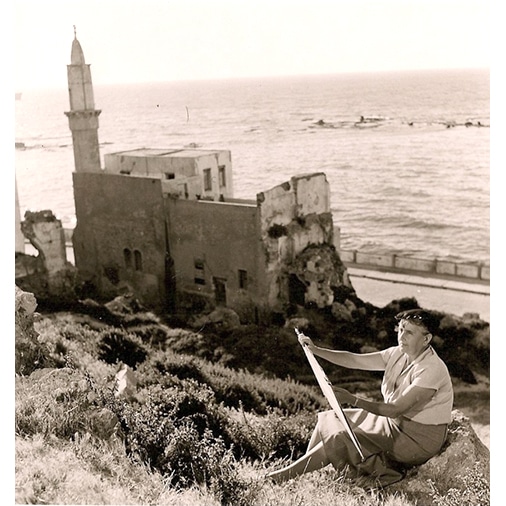
If Pascin renounced nationalism altogether, and Shalem merged nationalism, messianism, and mysticism, then Siona Tagger (1900–1988)—the only woman profiled here, and the only one born in Ottoman Palestine—deployed her art in the service of a new, largely secular, and modernist Zionist vision for Jewish Palestine. Some even celebrate her as the “first Israeli painter,” while others have gone so far as to claim that, uniquely among Jewish artists in Mandate Palestine and the early Israeli state, she had “no diasporic past.”
I first encountered one of Tagger’s paintings in graduate school as I perused the Historical Atlas of the Jewish People, but was completely unaware at the time of her Sephardic heritage, which was not mentioned in the atlas. Her father arrived to Palestine as a boy from Ottoman Bulgaria in 1868 (some sources say 1879 or 1880), and her mother came from an established Jerusalem family; Tagger’s parents, based in Jaffa, were thus deeply embedded in the Sephardic community of the pre-Zionist Old Yishuv. Significantly, she had knowledge of Ladino and Arabic in an era where some Palestinians also learned Ladino from their Sephardic neighbors.24 But just as her parents pursued a new path among the founders of Tel Aviv in 1909 (they were among the first residents of the city’s first multistory apartment building), Tagger also diverged from her community’s established precedent to emerge as one of the first, and most celebrated, women Israeli artists of the twentieth century. Even as she sought to escape the stigmas associated with her Sephardic background and her status as a woman, her peers in British Palestine and the early Israeli state—almost exclusively European-born, male, Ashkenazi Jewish painters—persisted in classing her as “other.”25
As much as the visual arts may have been marginal among Ottoman Jews, the taboo was compounded for women. Tagger therefore had to rebel against traditional cultural expectations on multiple fronts in order to pursue her work as an artist. Despite opposition from her mother, who expected her daughter to focus on marriage, her father, a successful furniture importer and leather merchant, could afford to pay for her studies and enjoyed seeing her excel at painting. Like Shalem, Tagger attended Bezalel—Shalem during World War I, and Tagger after the war. One wonders if the fact that the Bezalel’s founder, Boris Schatz, had previously lived in Sofia (in 1895, when Prince Ferdinand invited him to establish the Bulgarian Royal Academy of Art there) positively shaped his opinion of Tagger, given her family’s Bulgarian roots. But, continuing her rebellious approach, she departed from Bezalel’s Romantic Orientalist tradition in favor of modernist painting, an interest that she developed further while studying in Paris against her parents’ wishes. In Paris, Tagger studied under the well-known Fauvist and later Cubist painter André Lhote, who later worked with the Turkish-born Jewish artist Beki Molho.

The Jewish art world could not see past Tagger’s womanhood when appraising her art—or worse, it could not even see her at all. The prominent second Ha-Ohel Exhibition in Tel Aviv in 1927 (part of the “Exhibition of Modern Artists” that ran for two years) featured the work of fifteen artists, three of whom were women, including Tagger. The reviews of the show, however, never mentioned any of these women, let alone their art.26 In 1930, the noted Hungarian-born Jewish artist Shlomo Yedidia opined in Hebrew that “women’s artistic exhibitions always arouse certain skepticism. They are discomforting, disturbing for the viewer. She is always herself, she has to be ‘different,’ but beyond the originality inherent in her gender, it is a bridge to nowhere.”27 And about Tagger specifically, Yedidia wrote: “A woman artist indeed—individualistic by her very nature, perceptive, ‘different,’ gentle . . . she does not seek to express masculinity.”
Even after winning the prestigious Dizengoff art prize in 1937, Tagger’s work continued to be characterized principally by its allegedly feminine, even subpar, quality. A French-language Jewish newspaper in Cairo described Tagger’s style in 1936 as imbued with “sentimentality,” and attributed this exclusively to the fact that she was a woman, and a wife and mother at that—a status even more unusual for an artist at the time than being Jewish or specifically Sephardic. While Tagger did indeed marry and have children (who also pursued the arts), she soon divorced; her husband complained that she focused too much on her art and refused to cook. Art historian Tal Dekel observes that while Tagger never commented publicly about her status as the only woman and the only Sephardic or Mizrahi person among the most noted modernist Jewish painters in interwar Palestine, she “lived her life as a feminist.”28

Critics consider Tagger a modernist artist whose work bears the influences of Expressionism, Cubism, and Futurism. She later recalled her desire to bridge the cultures and aesthetics of the East and West: “I came to Paris to study a Western culture that wishes to merge with the East into one Mediterranean culture. I feel strongly rooted in the ground. The soil of Jaffa and the sands of Little Tel Aviv, where I grew up and which I love and paint.” She painted images of the Levantine world of her birth that reflected with an exotic and romantic flair, or even a “mystical quality,” the port of Jaffa and street scenes of British Palestine, where men in fezzes could still be found at the Tel Aviv souk: a tamarind merchant or a vendor of ka’ak (a sesame bread similar to Greek koulouri, Turkish simit, or the bagel).
The figures she depicted were not necessarily Jews but often Palestinian Arabs, with whom Tagger felt a sense of intimacy as an otherized, and arguably fetishized, member of society in the Yishuv. Such images helped to transform Jews, to make them closer to the land, in line with Zionist ideology. Yet Tagger also depicted scenes emblematic of modern technology, such as her famous oil painting “The Train Passing Through Neve Tzedek” (1928)—Neve Tzedek being the first Jewish neighborhood outside the old city of Jaffa, established by Sephardic families like her own. By embracing and blending two parallel versions of her contemporary space—as inhabited by “authentic” Oriental figures and transformed by technologies like the train—Tagger painted her vision of the Mediterranean world into existence, out of which the new Hebrew society was to grow.


Tagger’s interest in a Mediterranean synthesis of “East and West” also reflected her desire to develop a modern aesthetic language fit for the construction of a new Hebrew society in Palestine, to which she hoped to contribute. At least implicitly, she demonstrated the essential role that Sephardic Jews could play, in art as in politics, as intermediaries between the worlds of European Jews and of Palestinians. In fact, critics writing during the interwar years, and into the period of World War II, described Tagger as a “Palestinian artist,” or one of the few “native Palestinian artists,” who composed “Palestinian water-colours”—revealing how the ethnonational distinctions between “Jewish” and “Palestinian” had not yet crystallized as rigidly they would after 1948. She may have felt an affinity to the broader Arab world, as she showcased her paintings in 1938 at a gallery in Cairo, a city that at the time boasted an emergent anti-fascist arts scene organized around local Arab artists as well as Mutamaṣṣirūn, “Egyptianized” Europeans.29

Still, like Pascin, Tagger also represented Sephardic figures in the genre for which she became best known: portraiture. Along with her portraits of contemporary cultural icons, such as her well-known 1925 oil painting of Russian-born modern Hebrew poet Avraham Shlonsky, she also depicted her own Sephardic relatives: her mother, Sultana (who sometimes wore a veil covering her face), as well as her brothers and sisters. In this way, also like Pascin, she displayed her Sephardic heritage subtly in her work, in terms of her choice of subject.
Perhaps most revealingly, her paintings of her maternal grandfather, Yeshaya Bachar Schmuel, a notable figure in the Jerusalem Sephardic community, reflected the way in which the “other”—the Palestinian—was at the same time the “self”—the (Sephardic) Jew. In a series of images of her grandfather inside a Sephardic synagogue, with blue arches and a prominently displayed shiviti, Tagger depicted the spaces of her own family’s traditional religious world in a style indistinguishable from her representations of local (non-Jewish) Palestinian figures and their built environment. As artist and scholar Achia Anzi observes, Tagger’s images of her grandfather in his synagogue deeply resonate with the aesthetics of paintings like that of the Umar Mosque in 1932.29 These images may reflect how Tagger saw herself as “native,” along with Palestinians—or, as Anzi suggests, how she may have identified with Palestinians while appropriating their milieu.30


In envisioning herself as a Sephardic Jewish woman and a Levantine artist, Tagger certainly felt a sense of affinity for her Palestinian neighbors and made overtures toward imagining a future for a “shared homeland” (ha-moledet ha-meshutefet) for Jews and Palestinians, as many other early Sephardic Zionists did. But eventually, she committed to a vision for a new Hebrew society and a more exclusive Jewish state in Palestine. She served in the Haganah and, after thousands of Palestinians evacuated from Safed following the Palmach’s capture of the city in 1948, she purchased a former church, now emptied of its worshippers, to serve as an abode and studio in 1951. In this regard, her decision departed from the position of the Sephardic chief rabbi, Bension Hai Uziel, who, unlike many prominent Jewish public leaders, intellectuals, and rabbinical authorities, categorically refused to take possession of abandoned Palestinian property (even as he saw divine intervention as the ultimate source of their departure).31 In preparation for her grandchildren’s visit to her new residence in Safed, in a nod to the lost world once shared by Palestinians and Jews—and perhaps in an equivocal recognition of her own implicated status in the dispossession of Palestinians—she painted a crib she had acquired for them blue, to ward off the evil eye.32
The most famous artist in this group, Pascin embraced a hedonistic lifestyle while making a name for himself in the art scenes in New York and Paris. In his public persona, he did not center his Jewish identity (and certainly not his Sephardic identity), but neither did he deny his Jewishness as evidenced by his desire to be buried as a Jew. Just last year, in 2023, the synagogue of his childhood, in Viddin, Bulgaria, even reclaimed Pascin as their own by renaming the building, now a restored Jewish cultural center, in his memory.33 Yet Pascin was not only Jewish. He rejected nationalism of all kinds and Zionism in particular, and never set foot in Palestine. No matter how much he may have sought to escape being pigeonholed as Jewish, or as specifically Sephardic, he never freed himself from imagery associated with “the Orient.” To the contrary, he embraced the persona, conjured in the minds of art critics, of the “Oriental prince” whose ruin seemed almost inevitable. Already in the nineteenth century, the Prussian Jewish historian Heinrich Graetz characterized the Jews of the Ottoman Empire as having sunk into “enervation” and plunged into “utter darkness” following the downward trajectory of the empire itself. Graetz even compared each generation’s sultan to Sardanapalus, the protagonist of an ancient Greek tale about the self-inflicted, bacchanalian destruction of the last king of Assyria, purported to be an effeminate crossdresser.34 Thus, the characterization of Pascin as an “Oriental prince,” poised to fall after a short and sordid life, drew upon a vast repository of denigrating, Orientalist imagery long foisted upon Levantine Jews.
If Pascin’s trajectory was one of descent, Shalem followed the path of ascent—the literal meaning of aliyah, the Hebrew term for Jewish emigration to the Land of Israel. In Jerusalem, Shalem embraced religious Zionism and the new nationalist Hebrew culture, but he did not forsake his sense of connection to the world of the diaspora from which he came. His lithograph of the eighteenth-century Salonican synagogue—infused with Orientalist imagery and accompanied by biblical passages—served as a reminder of the city of his birth and its status as an ir va-em be-Yisrael, “city and mother in Israel,” one of the great Jewish centers in the diaspora. His religious Zionism, infused with mysticism and messianic aspirations, did not require the negation of the diaspora so much as the transmission of sparks from Salonica, a Sephardic Jewish center of old, to Jerusalem, the renewed capital of the Jewish people.
If Pascin’s tale is one of decline and Shalem’s a tale of ascent, Tagger followed yet a different path. Of the three artists, she was the only one born in Palestine, when it was still part of the Ottoman Empire. In this way, Tagger claimed the mantle of “the first Israeli artist.” But as a Sephardic /Mizrahi Jew, and as a woman in an overwhelmingly Ashkenazi male milieu of modernist artists in Mandate Palestine and then the state of Israel, Tagger experienced numerous obstacles to achieving the success and impact that she did. In her most important and well-remembered paintings–urban scenes of the emergent “Hebrew” cities and portraits of Hebrew-speaking intellectuals—Tagger retained a connection to the world of her upbringing, as reflected not only in depictions of “Oriental” types, but also in the Orientalized scenes of her grandfather’s Sephardic synagogue. These images reveal the multiple ambivalent relationships Tagger cultivated—with her family and their past, with her Palestinian neighbors, and with the mark they all left on the urban landscape. As much as she felt a sense of familiarity with Palestinian society and its aesthetics, she also participated in the burgeoning Zionist movement that sought to sharpen the differences—indeed, the divisions—between Palestinians and Jews in the land, to disentangle the two from each other, to set them in opposition to each other, to supplant the former with the latter, except as preserved in the scenes of a lost world of coexistence that she bequeathed to posterity in her art.
The biographies of Pascin, Shalem, and Tagger offer three divergent trajectories of artists of Sephardic heritage during the early twentieth century. The next installment of this series will offer biographies of two other artists of the same generation, also of Sephardic heritage: “the Sephardic Nationalist,” Daniel Kabiljo of Sarajevo, a recognized figure in the Bosnian art scene of the first half of the twentieth century; and “the Radical,” Angel Castro (also from Salonica), considered the most important artist of Sephardic heritage in New York in the 1930s, yet about whom virtually nothing has been written until now. A conclusion to the complete series will follow.
Footnotes
- Né Julius Mordecai Pincas. “Pascin,” his pseudonym, is an anagram of his surname, “Pincas.”
- My father, an artist himself, was the impetus for my interest in Sephardic modern art. See the first installment of this series here.
- The stories of Pascin’s exploits and adventures, and his reasons for traveling to America, are recounted by Alfred Werner in “The Painter Jules Pascin: A Jewish Bohemian,” Commentary, August 1958, [https://www.commentary.org/articles/alfred-werner/the-painter-jules-pascina-jewish-bohemian/] and “The Return of Jules Pascin,” The Jewish Quarterly 8, no. 2 (Spring 1961): 23-27. [https://issuu.com/benurigallery/docs/96_the_return_of_jules_pascin_by_alfred_werner]
- Passport application for Jules Pincas, Oct. 8, 1920, “U.S., Passport Applications, 1795-1925,” Ancestry.com, accessed May 28, 2024, http://www.ancestry.com. The note about his appearance is in a different handwriting, and seems to have been added by an official. Notably, according to these records, Pascin never officially changed his family name; it still appears as Pincas.
- Gaston Diehl, Pascin, trans. Rosalie Siegel (Milan: Uffici Press, 1968), dust jacket; cf. 6 and 89 for other references to Pascin as an “oriental prince.”
- Joann Sfar, Pascin, trans. Edward Gauvin (Minneapolis, MN: Uncivilized Books, 2016).
- Fanny Ganso, “Jules Pascin: An Informal Sketch,” Arts, June 1956, 30.
- Sadly, in the end, Pascin was not buried in a Jewish cemetery, but in Saint-Ouen, a municipal cemetery in a Paris suburb. He was later disinterred and buried at the famous cemetery in Montparnasse.
- Henry Besso, who was an early participant in the Sephardic Studies program at Columbia University in the 1930s, did maintain a file on Pascin among his personal papers, which included newspaper clippings, but no direct personal correspondence between Pascin and the Sephardic community in the US. See the Henry Victor Besso Papers, American Sephardi Federation, New York, box 32, folder 61.
- Alfred Werner, “Jules Pascin in the New World,” College Art Journal 19, no. 1 (1959), 30–39.
- See Mirjam Rajner’s Fragile Images: Jews and Art in Yugoslavia, 1918-1945 (Leiden: Brill, 2019) for discussions of Pascin’s work.
- Rajner, Fragile Images, 33.
- The “eternal flame,” a light that remains perpetually lit in every synagogue.
- Shalem seems to have been related to the prominent Ottoman Jewish lawyer, banker, and diplomat, Emmanuel Shalem, whose son, Raphaël Salem, became a famous mathematician in Paris.
- For an approach to Shalem’s work contextualized in the late Ottoman and Mandate Palestine, see Shalom Sabar, “Art and Folk Art,” in Yaron Ben-Naeh and Michal Held Delaroza, eds., Ha-Yishuv ha-Yashan ha-Sefaradi be-Erets Yisra’el = The Old Sephardi Yishuv in Eretz Israel (Jerusalem: Ben-Zvi Institute, 2023), 301–322.
- Shalem attended AIU’s vocational school in Jerusalem (Torah u-Melacha; Torah and Craft), which taught art and crafts before Bezalel was founded.
- The interview was published posthumously: “Megilat R”ASH,” in Gideon Ofrat, Al ha-Arets: Ha-Omanut ha-Eretsyisreʼelit (n.p., Golan, 1993), 1:63–72.
- For more trench art by Shalem, see the Jewish Joint Distribution Committee (JDC) Global Archives website, https://archives.jdc.org/trench-art
- An Hebrew acronym of the initials of his name.
- מִמִּזְרַח־שֶׁמֶשׁ עַד־מְבוֹאוֹ מְהֻלָּל שֵׁם יְהֹוָה (Psalms 113:3)
- On Ben-Gurion and Jabotinsky in Salonica, see Devin Naar, Jewish Salonica: Between the Ottoman Empire and Modern Greece (Stanford: Stanford University Press, 2016), 2.
- On the book of Daniel: Al Ge’ulat Yisra’el: Ha’arakhah ve-Umdanah al Shiv’ah Simanim shebe-Sefer Dani’el (Jerusalem: n.p., 1947 or 1948). On Maimonides: Bet ha-Mikdash: 12 Sirtutim shel Har ha-Bayit veha-Mikdash le Helkav (Jerusalem: published by the author, 1967).
- An acronym for the name of Rabbi Moshe ben Maimon, also known as Maimonides.
- Michelle Campos, “Remembering Jewish–Arab Contact and Conflict,” in Sandy Sufian and Mark LeVine, eds., Reapproaching Borders: New Perspectives on the Study of Israel-Palestine (Lanham, MD: Rowman & Littlefield, 2007), 41–65, 44.
- Tal Dekel, “From First-Wave to Third-Wave Feminist Art in Israel: A Quantum Leap,” Israel Studies 16, no. 1 (Spring 2011): 149-178; quote 153.
- Graciela Trajtenberg, “Art Criticism and its Power Over Women Artists–An Inquiry into the Sources of Gender Discrimination in Jewish Palestine/Israel, 1920-1960,” Journal of Historical Sociology 31, no. 4 (December 2018): 469-482.
- Trajtenberg, “Art Criticism and its Power Over Women Artists.” Trajtenberg is translating Yedidia’s quotes in Hebrew from an article in Ketuvim, April 24, 1930.
- Dekel, “From First-Wave to Third-Wave Feminist Art in Israel,” 153.
- Don LaCross, “Egyptian Surrealism and ‘Degenerate Art’ in 1939,” Arab Studies Journal 18, no. 1 (2010): 78–117.
- Achia Anzi, “Settler Mimicry: Colonization and Decolonization through Imitation,” Palestine/Israel Review 1, no. 1 (2024): 155–185.
- Hillel Cohen, Sonʼim Sipur Ahavah: Al mizrahim ve-’Arvim (ve-Ashkenazim gam) me-Reshit ha-Tsiyonut ve-ad Meʼoraʼot 2021 Enemies, a Love Story: Mizraḥi Jews, Palestinian Arabs and Ashkenazi Jews from the Rise of Zionism to Present (Tel Aviv: Ivrit Hotsa’ah la-or, 2022), 88–89.
- Ofra Gouri-Rimon, “From Safed to Eilat,” Sionah Tagger (the artist’s memorial and biographical website), https://www.tagger-siona.co.il/en/about/#from-safed-to-eilat.
- “Bulgaria: With gala ceremony, the restored Vidin synagogue, which long stood derelict, opens as the Jules Pascin cultural centre,” September 4, 2023, Jewish Heritage Europe (website), https://jewish-heritage-europe.eu/2023/09/04/bulgaria-vidin-synagogue/.
- The figure of Sardanapalus recurred in modern Europe in the eponymous Orientalist play by Lord Byron (1821) and in Delacroix’s painting The Death of Sardanapalus (1827).
Dr. Devin E. Naar is the Isaac Alhadeff Professor in Sephardic Studies and Associate Professor of History at the Stroum Center for Jewish Studies in the Jackson School of International Studies at the University of Washington. A former Fulbright scholar with a PhD in History from Stanford University, Naar founded and chairs the UW’s internationally recognized Sephardic Studies Program. His first book, Jewish Salonica: Between the Ottoman Empire and Modern Greece, won a 2016 National Jewish Book Award and the 2017 prize for best book awarded by the Modern Greek Studies Association. His essays have also appeared in the Washington Post, Jewish Currents, Jewish Review of Books, Tablet Magazine, and Public Radio International. While he conducts research in six languages, Dr. Naar speaks his ancestral language, Ladino, with his two children.